Stop Bailing: Why Your Boat Needs a Solar Powered Bilge Pump
There are few things more disheartening for a boat owner than arriving at the marina or the lake house after a heavy storm, only to find your tender, dinghy, or boat cover sagging under the weight of rainwater. What should be a relaxing day on the water immediately turns into a labor-intensive maintenance session. You grab the bucket or the hand pump, and you start the tedious, back-breaking work of bailing out gallons of water before you can even think about starting the engine.
For decades, this was simply the price of admission for owning an open boat or using a canvas cover. If you didn’t have a sophisticated, hard-wired electrical system to run an automatic pump, you were the pump. But technology has finally caught up to the needs of the casual boater and the small craft owner. The solution isn’t a bigger bucket; it’s a solar powered bilge pump.
These self-contained units have revolutionized how we protect our vessels from the elements. By harnessing the sun’s energy, they offer a set-it-and-forget-it solution to water accumulation. Whether you own a RIB, a Boston Whaler, or simply struggle with water pooling on your boat cover, understanding how these devices work can save you time, protect your investment, and ultimately save your back.
Understanding the Weight of Rain
To understand the value of an automatic pump, you first have to respect the sheer physical force of water. It is deceptively heavy. A single gallon of fresh water weighs approximately 8.6 pounds. That might not sound like much when you are carrying a milk jug, but it adds up with frightening speed during a downpour.
A significant rainstorm can easily dump 50 gallons of water or more into an uncovered dinghy or onto a sagging canvas cover. That is 430 pounds of dead weight pressing down on your hull, straining your transom, or testing the tensile strength of your boat cover.
For small tenders and fiberglass boats, this accumulation does more than just make the floor wet. The added weight can push the vessel lower in the water, potentially below the scuppers or self-bailing lines, leading to a reverse flow that sinks the boat at the dock. For boat covers, that heavy puddle stretches the fabric, ruins the waterproofing, and can eventually snap the support poles or tear the canvas entirely. A solar powered bilge pump acts as a proactive defense system, removing this weight as it arrives rather than letting it accumulate.
How the Technology Works
The beauty of modern solar marine technology lies in its simplicity and independence. Unlike traditional bilge pumps that require complex wiring to a 12-volt marine battery (which can die if the pump runs too often), a solar powered unit is entirely self-contained.
Energy Independence
These pumps feature integrated, high-efficiency solar panels that constantly harvest energy from the sun. This energy isn’t just used to run the motor in real-time; it charges an internal battery. This is a critical distinction. A pump that only runs when the sun is shining would be useless during a dark, stormy night—exactly when you need it most. By utilizing an internal battery, these systems can operate 24/7, detecting and pumping water even in the middle of a midnight squall.
Smart Automation
The “set-it-and-forget-it” aspect comes from intelligent internal sensors. You don’t need to walk down to the dock to flip a switch. The device monitors water levels electronically. When water is detected, the pump activates automatically, removes the water, and shuts itself down to conserve energy once the job is done. This cycle repeats indefinitely, ensuring your bilge or cover stays dry without you lifting a finger.
Portable Versatility: No Wires, No Holes
One of the biggest hurdles to installing a traditional bilge pump is the installation itself. Drills, sealants, wire strippers, and fuses are usually required. You have to route cables through the hull and worry about watertight connections.
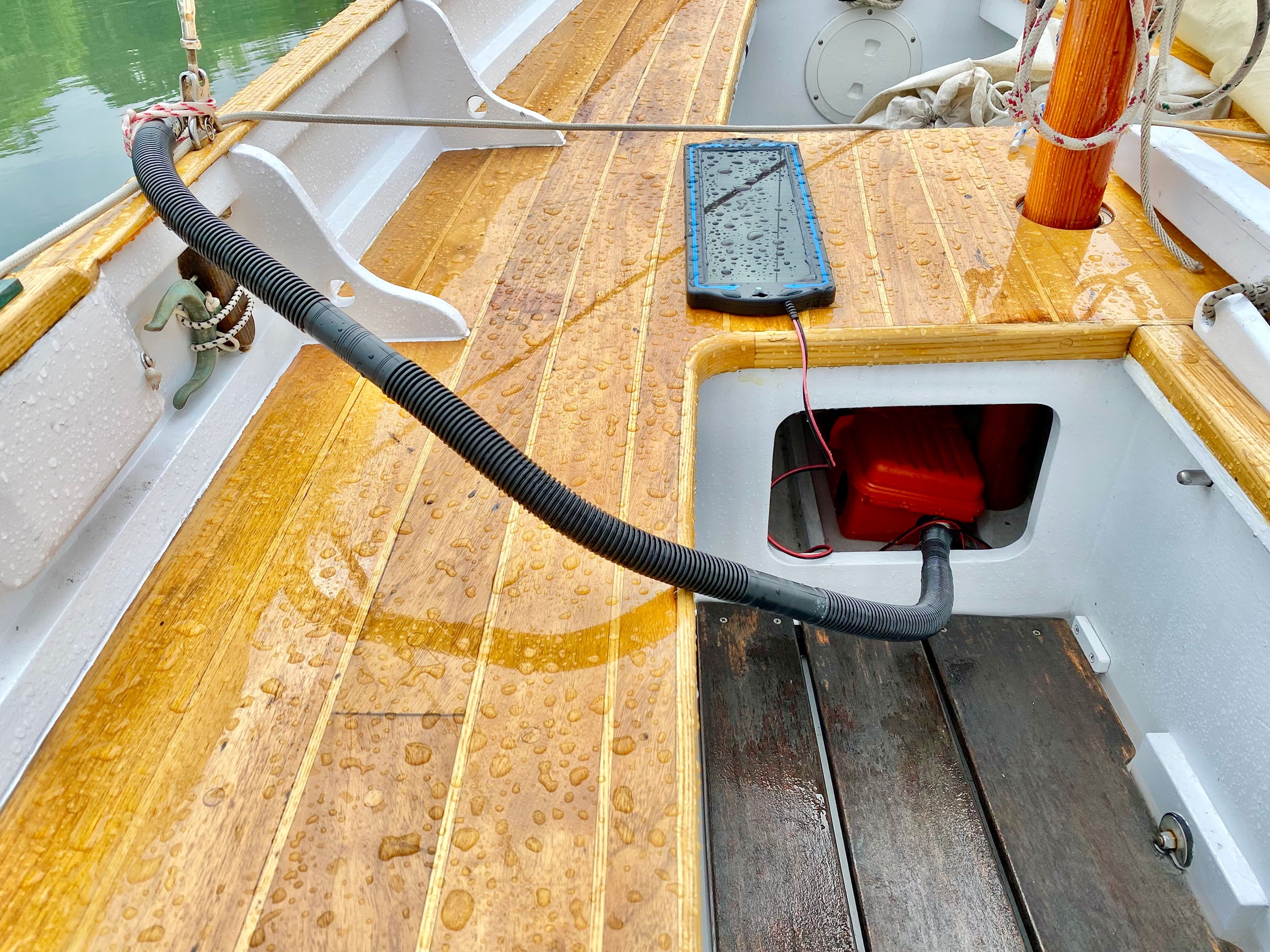
A portable solar powered bilge pump eliminates this installation barrier entirely. Because they are self-contained, there is no wiring required. You simply place the unit where the water collects, route the discharge hose over the side, and walk away.
This portability opens up a wide range of applications that wired pumps simply cannot handle:
- Dinghy and Tender Protection: Small inflatables and hard-bottom tenders often lack a power source. A portable solar unit drops right into the transom area to keep them floating high.
- Boat Cover Maintenance: This is perhaps one of the most innovative uses. By placing the pump on top of a boat cover where water usually pools, you can prevent the “swimming pool effect” that ruins expensive canvas.
- Emergency Backups: Even on larger yachts with hard-wired systems, main batteries can fail. Having a solar unit on standby provides a layer of redundancy that can save a vessel during a long-term power outage.
Durability in Harsh Marine Environments
Electronics and water generally do not mix, and saltwater is particularly destructive. When choosing a water removal system, the build quality determines whether the device will last a decade or a month.
The most reliable units on the market utilize industrial-grade materials designed specifically for the marine environment. You should look for pumps constructed with 316 stainless steel for the intake and outlet ports. Unlike lower grades of metal, 316 stainless steel offers superior resistance to chlorides (salt), making it essential for ocean-going vessels.
Additionally, the housing should be made of robust, UV-resistant plastics like ABS. Since these pumps live their lives in direct sunlight, inferior plastics will become brittle and crack over time. A high-quality solar pump is designed to bake in the sun and sit in the rain without degrading.
The Problem with Manual Bailing
Beyond the physical exertion, manual bailing is a reactive strategy. You are only fixing the problem after the damage potential has already occurred.
If your boat sits full of water for three days before you can get to the marina, that is three days of unnecessary stress on the hull structure. It is three days where osmosis (water penetrating the fiberglass gel coat) can begin to occur. It is three days for mosquitoes to breed in the stagnant water, and for mold and mildew to take hold of your upholstery and floorboards.
Furthermore, manual bailing is never 100% effective. A scoop or a bucket always leaves a layer of water at the bottom. Sponges help, but they are slow. A precision-engineered pump can remove very low levels of water, leaving the area virtually dry. This helps maintain the cleanliness and value of the vessel over time.
Choosing the Right Setup
When looking to upgrade to a solar powered bilge pump, consider the hose length and material. A silicone hose is often preferred over cheap PVC tubing. Silicone remains flexible in both scorching heat and freezing cold, and it resists UV damage. A hose that cracks or splits renders the pump useless, so high-quality discharge lines are a must.
You also want to look for a low-profile design. In a small dinghy or a shallow bilge, vertical space is at a premium. A compact, flat unit is less likely to be kicked over or get in the way of your gear.
A Smarter Way to Boat
Boating is supposed to be about freedom and enjoyment, not chores. Every minute you spend scooping water out of a dinghy is a minute you aren’t spending out on the water.
Transitioning to an automatic, solar-powered solution is more than just a convenience upgrade; it is a way to protect the longevity of your boat. By ensuring water never has the chance to accumulate, you prevent structural stress, protect your covers, and ensure that your vessel is always ready to go when you are. Whether you are protecting a pristine Boston Whaler, a reliable RIB, or just trying to keep your boat cover from collapsing, the sun provides all the power you need to keep your boat dry.
Embrace the Automatic Solution
If you are still relying on a bucket, or if you are tired of replacing boat batteries drained by hard-wired pumps, it is time to rethink your water removal strategy. A solar powered bilge pump offers the reliability of a wired system with the portability of a manual one.
Don’t let the next rainstorm ruin your plans. Invest in equipment that works as hard as you do, even when you aren’t there to watch it.