
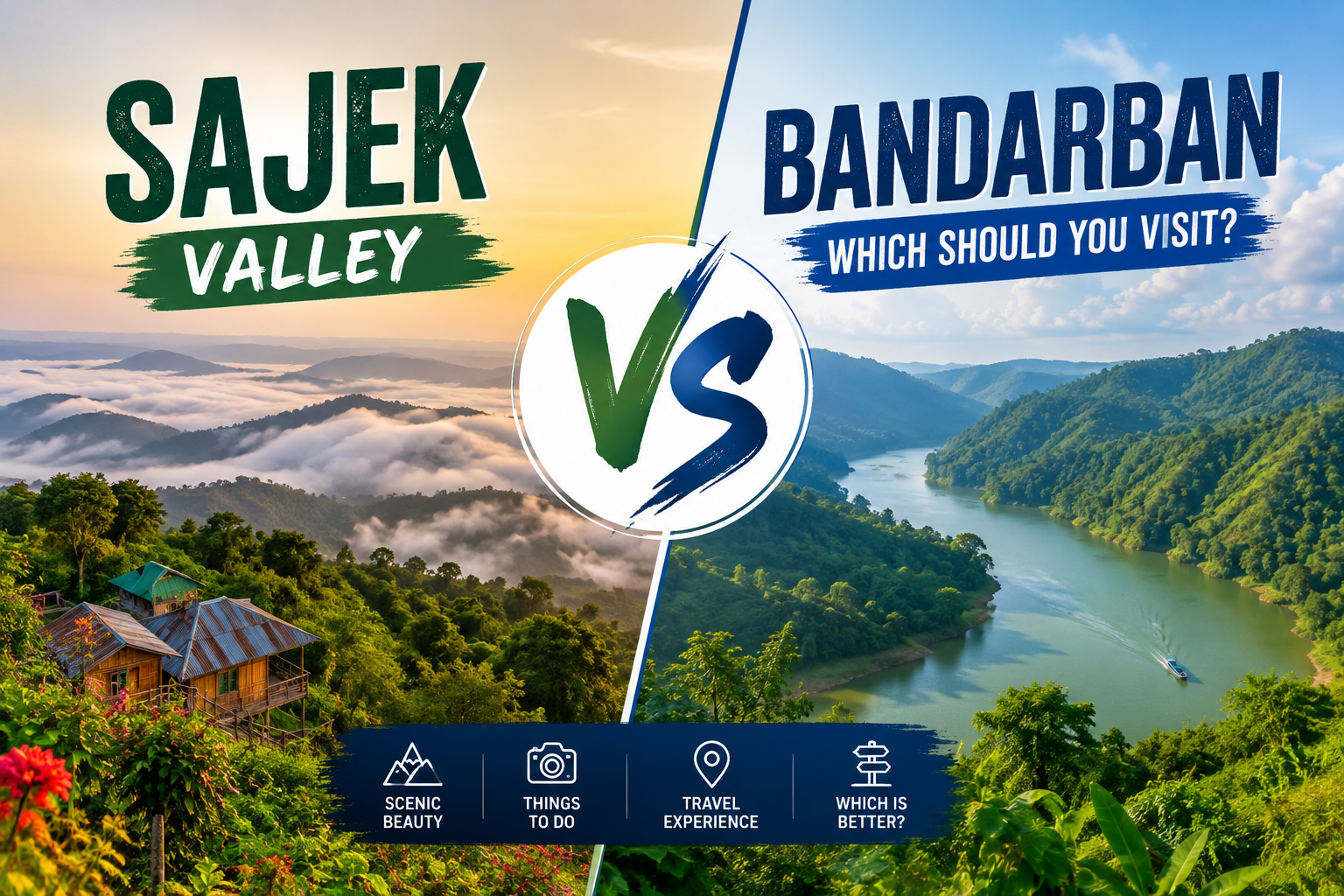
Sajek Valley vs Bandarban: Which Bangladesh Hill Destination Should You Visit First?
Sajek Valley and Bandarban are Bangladesh’s most popular hill stations, and any traveler making plans for visiting the Chittagong Hill Tracts will inevitably ask about both and be tempted to visit both. However, very few sources will compare the two, and for good reason, they are vastly different experiences. While one can be a relaxing getaway easily fit into a short weekend, the other requires a more serious commitment of fitness and time, including a mandatory guide. Read on to learn more about the differences between Sajek and Bandarban and decide which you want to see, or have time to see, on your trip to Bangladesh’s Chittagong Hill Tracts.
While both Sajek and Bandarban have accommodations and other comforts, one is a serious hiking adventure while the other is a more mild getaway perfect for short trips.
Quick Comparison Table
| Sajek Valley | Bandarban | |
| Type of experience | Scenic, atmospheric, cloud views, easy relaxation | Adventure/trekking, peaks, lakes, remote waterfalls |
| Minimum days needed | 2 days / 1 night | 3-4 days for major attractions; 5-7 for deep treks |
| Physical difficulty | Low, minimal walking | Moderate to high multi-hour hikes, river crossings |
| Permit/access complexity | CHT foreigner permit + army escort convoy | CHT foreigner permit + mandatory local guide for remote treks |
| Best known for | The “sea of clouds” rolling through the valley | Boga Lake, Keokradong peak, Nafakhum waterfall |
| Typical budget range | Lower—day trips and short stays keep costs down | Higher for multi-day treks—guide fees, permits, remote logistics |
| Crowd level | High and rising, increasingly commercialized | Low in remote zones, more moderate near Bandarban town |
| Best for | First-timers, families, photographers, limited time | Trekkers, adventure travelers, those chasing remote terrain |
Nothing else online lays these two destinations out against each other this directly, use this table as your starting point, then read on for the reasoning behind each row.
Sajek Valley at a Glance
- What makes it famous
Sajek’s signature draw is the “sea of clouds” effect—mist rolling directly through the valley and villages at elevation, especially at sunrise. Add relatively easy vehicle access via jeep or Chander Gari and resort-style bamboo cottages with private valley-view balconies, and it’s easy to see why Sajek photos dominate Bangladeshi travel social media.
- What kind of trip it is
This is a relaxed, scenic escape—minimal walking involved. Most of what makes Sajek worth visiting is accessible by vehicle or a short stroll between viewpoints. It’s about atmosphere and views, not physical challenge, which makes it approachable for a much wider range of travelers than Bandarban’s remote treks.
- Realistic time needed
Two days and one night is commonly cited as a comfortable minimum, enough time for a sunset, a sunrise cloud-viewing session, and the main viewpoints without needing to build in recovery time from physical exertion.
Bandarban at a Glance
What makes it famous?
Bandarban is real trekking terrain: Boga Lake (a highland crater lake also known as Bagakain Lake), Keokradong peak (one of Bangladesh’s higher points), and remote waterfalls like Nafakhum and Amiakhum that require genuine effort to reach.
What kind of trip is it?
This is genuine multi-day trekking country. Remote zones require a mandatory local guide, journeys often combine boat travel with hiking, and the physical demand is considerably higher than in Sajek, think multi-hour treks over dirt paths, bamboo forests, and rolling ridgelines, sometimes with river crossings involved.
Realistic time needed
Day-trip-accessible spots near Bandarban town—Nilgiri, Shoilo Propat, the Golden Temple—can be covered in a minimum of 3-4 days. But if you’re after the deeper treks to Boga Lake, Keokradong, or Nafakhum, plan for 5-7 days to do it properly rather than rushing the terrain.
Head-to-Head Comparison
Landscape & Scenery
Sajek offers cloud-filled valley views from a fixed set of elevated viewpoints—dramatic, but relatively uniform in character across your visit. Bandarban offers considerably more varied terrain: peaks, a highland lake, waterfalls, and river valleys, spread across a much larger and more physically demanding area.
Physical Difficulty
Sajek involves light walking between viewpoints—genuinely accessible to most fitness levels. Bandarban’s remote treks involve real trekking: multi-hour hikes on steep dirt paths, river crossings, and terrain that punishes anyone who underestimates the heat and humidity. If you’re not currently in reasonably good hiking shape, the deeper Bandarban routes are not the place to find out.
Accessibility
Sajek is reachable by jeep or Chander Gari along a paved-ish route, with the army escort convoy handling the final stretch. Bandarban’s remote zones are a different proposition entirely — reaching Boga Lake or Keokradong typically means a drive to Ruma Bazar, then a mandatory local guide, then hours of trekking (and sometimes a boat leg) to actually arrive.
Permits & Escort Requirements
Both destinations require the same baseline: the Chittagong Hill Tracts foreigner permit. Where they diverge is the on-the-ground access process. Sajek’s system centers on the army escort convoy at fixed daily windows from Dighinala. Bandarban’s remote treks instead center on a mandatory local guide requirement, in Ruma, for instance, there’s a tourist registration office where you’re required to take a registered guide before continuing toward Boga Lake or Keokradong, and permission from the local army camp is needed before setting out, with a same-day cutoff time for departure.
Time Needed
Two days deliver a genuinely satisfying Sajek trip. Bandarban’s time requirement scales with how deep you want to go—3-4 days covers the accessible highlights near town, while 5-7 days is realistic if Boga Lake, Keokradong, and Nafakhum are all on your list.
Cost
Sajek is generally the more budget-friendly option for a short trip. Day trips and one-night stays can keep transport, accommodation, and permit costs relatively low. Bandarban’s multi-day treks usually cost more because of guide fees, permits, remote-area transportation, and multiple nights of accommodation. Exact costs vary by season and tour operator, so check the latest rates before planning your budget. If you want an easier way to plan your trip, you can explore a Sajek Tour Package.
Crowds & Overtourism
Worth being honest about this one: Sajek has become significantly more crowded and commercialized in recent years, as domestic tourism to the valley has surged—expect company at the main viewpoints, especially on weekends and holidays. Bandarban’s remote trekking zones, by contrast, remain comparatively untouched simply because the physical barrier to entry keeps casual tourist volume much lower.
Culture & Indigenous Communities
Both regions are home to indigenous communities, but the nature of your interaction differs. In Sajek, visits to nearby communities tend to be a more deliberate, standalone activity. In Bandarban, trekking routes to remote destinations often pass directly through Mro, Marma, Bawm, and other indigenous villages along the way, making cultural contact a more organic (though still important to approach respectfully) part of the journey itself rather than a separate stop.
Which Should You Visit First? (Decision Framework)
- First-time visitors with limited time (2-3 days) → likely Sajek. Easier logistics, a near-guaranteed scenic payoff, and far less physical demand make it the lower-risk choice for a first Chittagong Hill Tracts trip.
- Trekkers and adventure travelers → likely Bandarban. The real payoff here—Boga Lake, Keokradong, and Nafakhum—genuinely requires the time and physical investment, and that’s exactly what serious trekkers are looking for.
- Photographers chasing the “cloud sea” shot → Sajek, hands down. This specific effect is Sajek’s defining feature and isn’t really replicated at Bandarban.
- Travelers who want to avoid crowds and go remote → Bandarban’s deeper zones, where the physical barrier to entry naturally limits visitor volume.
- Families or less physically able travelers → Sajek. The minimal walking and vehicle-accessible viewpoints make it workable for a wider range of ages and fitness levels.
- Travelers planning a longer Bangladesh trip who can do both → do Sajek first. It’s a
genuinely practical sequencing choice, not just a preference: Sajek gets you comfortable with the CHT permit process, the checkpoint system, and general hill-tract travel logistics on an easier trip before you take that same baseline knowledge into Bandarban’s more demanding terrain and guide requirements.
Can You Combine Both in One Trip?
It is easy to visit both Sajek and Bandarban in one trip if you plan your trip throughout the Green Belt Bangladesh. You can easily and pleasantly visit both locations with the appropriate plan.
Realistic combined itinerary length
Combining both destinations in one trip is realistic if you have the time, figure roughly 7-9 days total to do both properly (2-3 days for Sajek, 5-7 for a meaningful Bandarban visit including a real trek), though this varies depending on how deep into Bandarban you go and how tightly you can connect the transit legs. Since Sajek sits in the Rangamati district and Bandarban is a separate district entirely, treat this as two distinct legs of a trip rather than an easy add-on, and confirm current routing feasibility with a local operator before locking in dates.
Logistics of moving between the two
Practically, this usually means routing back through a shared hub—Chittagong city is the most common connecting point, since both Rangamati/Sajek and Bandarban have reasonably direct road connections to and from Chittagong, even though there’s no direct route between the two hill destinations themselves.
Does one CHT permit cover both districts?
This is genuinely something to confirm directly with official sources rather than assume either way, guidance on whether a single Chittagong Hill Tracts foreigner permit application covers multiple districts or whether Rangamati and Bandarban each require their own separate application isn’t consistently stated across sources. If you’re planning a combined trip, raise this specifically when applying (see our dedicated Sajek Valley permit guide for the step-by-step application process) rather than assuming your Sajek permit automatically extends to Bandarban.
Frequently Asked Questions
Is Sajek Valley or Bandarban better for beginners?
Sajek, without much debate. It requires far less physical effort, has simpler logistics, and delivers a reliable scenic payoff without the trekking commitment Bandarban’s best spots demand.
Which is more difficult, Sajek or Bandarban?
Bandarban, considerably so, especially its remote treks to Boga Lake and Keokradong, which involve multi-hour hikes, elevation change, and sometimes river crossings, versus Sajek’s light walking between viewpoints.
Can I visit both Sajek Valley and Bandarban on one trip?
Yes, if you have roughly a week or more to spare. They’re separate districts without a direct route between them, so plan the trip as two connected legs, typically routed through Chittagong.
Which is more expensive, Sajek or Bandarban?
Bandarban’s multi-day treks generally cost more overall, given mandatory guide fees and multiple nights of remote-area logistics—Sajek is typically the more budget-friendly option for a short trip.
Do I need a guide for Bandarban but not Sajek?
Largely yes. Bandarban’s remote treks to Boga Lake and Keokradong require a mandatory registered local guide picked up at Ruma Bazar. Sajek doesn’t have an equivalent mandatory-guide requirement, though the army escort convoy plays a comparable role in controlling access to the final stretch of road.
Which has better views, Sajek or Bandarban?
It depends on what you’re after—Sajek delivers a specific, dramatic cloud-sea effect that’s hard to match anywhere else in Bangladesh, while Bandarban offers a wider variety of terrain (peaks, lakes, and waterfalls) spread across a much larger area.
Final Verdict
Choose based on your fitness level, the time you actually have, and whether you want scenery or adventure, not just which one is trending on social media this month. If you’re short on time, new to hill-tract travel, or traveling with people who don’t want a physical challenge, Sajek is the lower-risk, higher-certainty choice. If you have five-plus days, reasonable fitness, and want the kind of remote trekking payoff that Bangladesh genuinely doesn’t offer in many places, Bandarban is where that trip lives. And if your schedule allows it, doing Sajek first as an easier introduction before tackling Bandarban’s terrain is a sequencing choice worth taking seriously, not just a compromise.