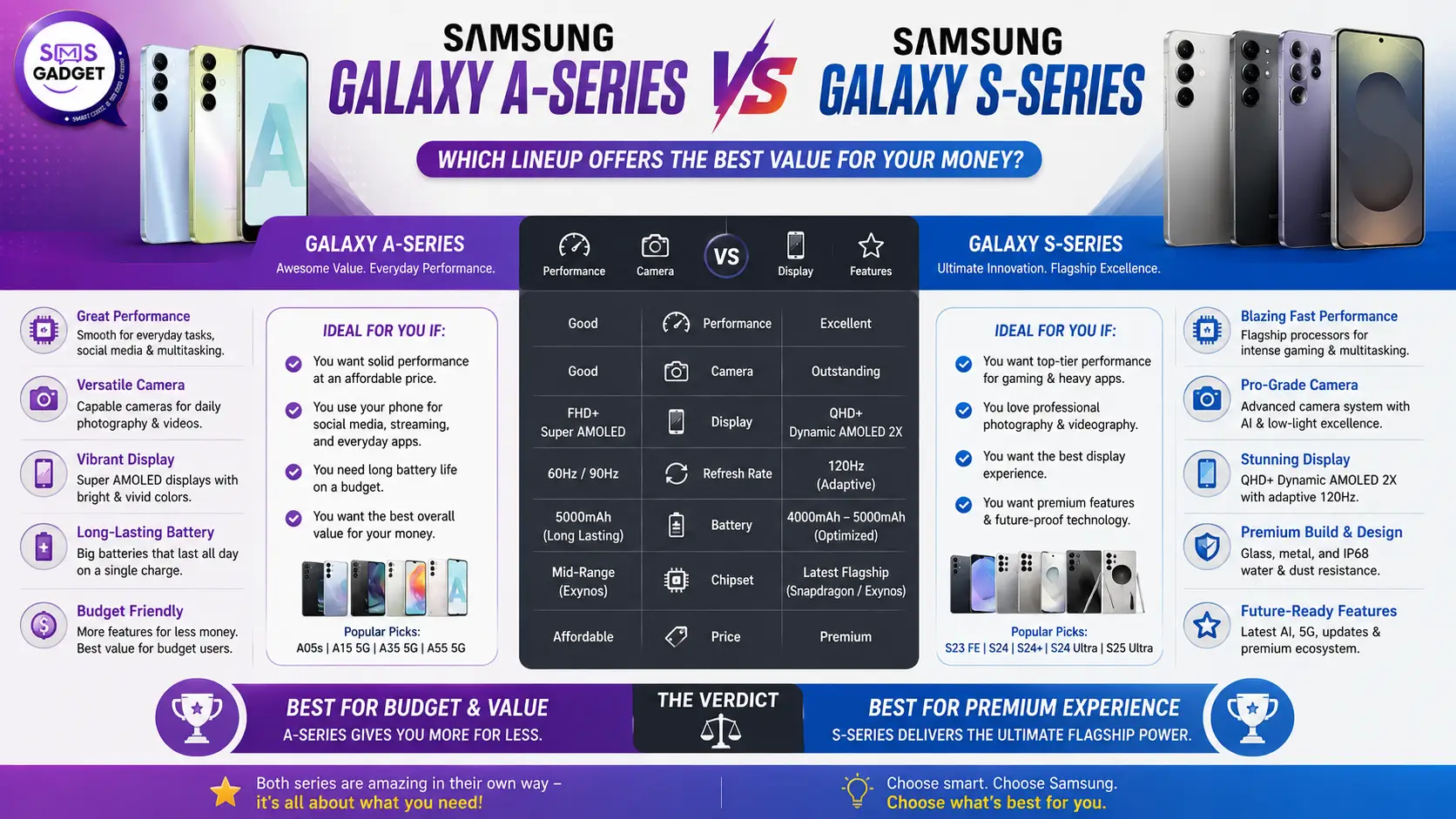
Samsung Galaxy A-Series vs S-Series: Which Lineup Offers the Best Value for Your Money?
Choosing between Samsung’s Galaxy A-Series and S-Series can feel confusing at first, since both lineups share the same One UI software and similar-looking designs. But once you look past the surface, the two series are built for very different types of users.
The S-Series is built for power users who want flagship performance, premium cameras, and long-term software support, while the A-Series is built for everyday users who want reliable performance and strong battery life at a much lower price.
In this guide, we’ll break down the real differences in design, display, performance, camera, battery, software support, and price, so you can decide which lineup actually offers the best value for how you use your phone.
Samsung A-Series vs S-Series: Quick Overview
| Category | Galaxy A-Series | Galaxy S-Series |
| Target User | Budget-conscious, everyday users | Power users, professionals, gamers |
| Build Material | Plastic / polycarbonate | Glass and metal |
| Display | Super AMOLED, Full HD | Dynamic AMOLED 2X, higher resolution, adaptive refresh rate |
| Processor | Mid-range chipsets (e.g., Snapdragon 6/7 series, Exynos mid-tier) | Flagship chipsets (Snapdragon 8 series) |
| Camera | Decent multi-lens setup, good in daylight | Advanced multi-lens setup, excellent in all lighting |
| Battery | Large capacity, power-efficient chipset | Smaller capacity but highly efficient, faster charging |
| Software Updates | Fewer years of updates, slower rollout | Longest update support, updates arrive first |
| Price Range | Budget to mid-range | Premium to ultra-premium |
| Resale Value | Depreciates faster | Holds value significantly better |
1. Design and Build Quality
The S-Series uses glass and metal construction, giving it a more premium, refined feel along with better heat dissipation during heavy use. Most S-Series models also carry IP68 water and dust resistance as standard.
The A-Series relies on plastic or polycarbonate builds. While this means it feels less premium in hand, it’s also lighter and generally more resistant to everyday drops and scratches — a practical advantage for daily use.
S-Series wins on premium feel; A-Series wins on everyday durability and lighter weight.
2. Display Quality
Both series use Super AMOLED technology, so colors look vibrant on either lineup. The real difference is in the details:
- S-Series: Higher resolution panels, better peak brightness, and adaptive refresh rates (up to 120Hz) that adjust automatically based on what you’re doing.
- A-Series: Full HD Super AMOLED screens that look sharp for everyday use but typically lack adaptive refresh rate and the extra brightness boost.
For casual browsing, streaming, and social media, the A-Series display is more than enough. For gaming, video editing, or content creation, the S-Series display makes a noticeable difference.
3. Performance and Chipset
This is where the two lineups separate the most.
- S-Series ships with Samsung’s most advanced chipsets available that year (typically the latest Snapdragon flagship processor), paired with higher RAM and better thermal management for sustained performance during gaming, multitasking, or video editing.
- A-Series uses mid-range chipsets that are efficient and handle everyday tasks — calls, browsing, social media, and light gaming smoothly, but they aren’t built to push demanding games or heavy editing software at full settings.
If your phone use involves gaming, 4K video editing, or heavy multitasking, the S-Series is worth the investment. If you mainly use your phone for communication, browsing, and streaming, the A-Series chipset is more than capable.
4. Camera Performance
Samsung has significantly narrowed the camera gap between the two series in recent years, but differences remain:
- S-Series: Higher megapixel main sensors, advanced zoom capabilities (especially on Ultra models), and consistently strong performance in low light thanks to larger sensors and better image processing.
- A-Series: Multi-lens setups that perform well in good lighting and daylight conditions but tend to struggle more in low light compared to the S-Series.
If photography is a top priority, especially night shots or zoom-heavy photography, the S-Series delivers a clearly better experience. For everyday photos and social media content, the A-Series performs impressively for its price.
5. Battery Life and Charging
Interestingly, battery capacity doesn’t always tell the full story.
- A-Series phones typically pack larger battery capacities (often 5,000mAh) paired with power-efficient mid-range chipsets, resulting in strong all-day battery life.
- S-Series phones often have slightly smaller batteries, but their more efficient flagship chipsets can deliver comparable or even better screen-on time, along with faster wired and wireless charging speeds.
Both series offer solid battery life, but the S-Series generally charges faster, while the A-Series wins on raw battery capacity.
6. Software Updates and Long-Term Support
This is one of the most overlooked but important factors in long-term value.
- S-Series devices receive software updates first and for the longest duration, since they’re Samsung’s flagship priority line. This means access to newer Android versions, security patches, and Galaxy AI features earlier and for more years.
- A-Series devices still receive regular security updates and OS upgrades, but typically for a shorter period and with a slower rollout compared to the S-Series.
If you plan to keep your phone for 4+ years, the S-Series offers better long-term software security and relevance.
7. Price and Resale Value
The price gap between the two lineups is significant, and it directly reflects the hardware and support differences covered above. The A-Series is priced to be accessible, while the S-Series sits in the premium bracket with pricing that reflects its flagship components and longer support window.
If you’re deciding which model fits your budget, it’s worth comparing the current Samsung Galaxy mobile price in Bangladesh across both lineups before making a final decision, since pricing and available models can shift with new releases.
Resale value is another important factor: S-Series phones tend to hold their value significantly better over time, thanks to strong brand trust and longer software support. A-Series phones, while still resellable, generally depreciate faster.
If you upgrade every 2–3 years and care about resale value, the S-Series often balances out its higher upfront cost. If you’re on a tighter budget or don’t resell often, the A-Series offers better immediate value.
Who Should Buy the A-Series?
The A-Series is the smarter choice if you:
- Are on a budget or want the best value for money
- Use your phone mainly for calls, messaging, social media, and streaming
- Want strong battery life without paying a premium
- Are buying a second phone, or a phone for a student or family member
Who Should Buy the S-Series?
The S-Series is worth the investment if you:
- Play graphics-intensive games or use demanding apps regularly
- Care about photography, especially in low light or with zoom
- Want the longest software support and access to the newest Galaxy AI features
- Plan to keep your phone for several years and value strong resale value
Frequently Asked Questions
Is the Samsung A-Series good enough for gaming?
The A-Series can handle most casual and mid-tier games smoothly, but it’s not built for graphics-intensive, high-frame-rate gaming. For serious mobile gaming, the S-Series is the better choice.
Does the S-Series really last longer than the A-Series?
Yes. S-Series phones typically receive more years of software updates and hold their resale value better, making them a stronger long-term investment despite the higher upfront cost.
Is it worth paying extra for the S-Series if I only use basic apps?
Not necessarily. If your daily use is limited to calls, messaging, and browsing, the A-Series delivers the same core experience at a much lower price, without unnecessary extra cost.
Which series has a better camera for everyday photos?
For daylight and casual photography, both series perform well. The S-Series pulls ahead mainly in low-light and zoom photography, which matters most to users who prioritize photography.
Final Verdict
There’s no universal “better” option between the Samsung Galaxy A series and S series—the right choice depends entirely on how you use your phone. The A-Series is the practical pick for everyday users who want reliability and battery life without overspending, while the S-Series is built for those who want top-tier performance, camera quality, and long-term software support.
Whichever lineup fits your needs, it’s a good idea to compare current models and pricing or visit a trusted Samsung Mobile shop before making your final decision this way you can see the latest models in person and choose the one that truly matches your budget and usage.