The Ultimate Showdown Titanium vs. Steel Sheet Metal How to Avoid Material Selection Errors That Drive Costs Up by 50%
Introduction
Engineers and procurement specialists often face a critical dilemma when selecting materials for sheet metal parts that demand high strength, light weight, or superior corrosion resistance: Titanium or Steel? Relying solely on material datasheets can lead to premature part failure, skyrocketing manufacturing complexity, or severe budget overruns. The core issue stems from overlooking real-world manufacturability, the impact of processing on material properties, and the total cost of ownership across the part’s lifecycle. This article moves beyond simple parameter comparisons. It provides a systematic decision framework for metal fabrication material selection from three dimensions: manufacturability, cost analysis, and application context, coupled with validation strategies for the prototyping phase. To make an informed choice, it is essential to delve into the following key questions.
Titanium vs. Stainless Steel: Which Offers a Better Strength-Corrosion Combo for Extreme Environments?
In the arena of high strength sheet metal materials, the battle of titanium vs steel for fabrication hinges on strength-to-weight ratios and corrosion mechanisms. Take Grade 5 titanium (Ti-6Al-4V); its specific strength (strength/density) far exceeds that of any stainless steel, making it the premier choice for weight-sensitive aerospace applications. In corrosion resistance, titanium relies on an incredibly dense, self-healing oxide layer (passive film) for ultimate protection, resisting nearly all forms of chloride and chemical attack.
In contrast, 300-series stainless steels (like 304, 316) depend on sufficient chromium content (>10.5%) to form a protective chromium oxide layer. This is adequate for most outdoor and industrial environments, offering a significant cost advantage. Therefore, for prolonged immersion in marine environments or harsh chemical processing, titanium is the undisputed final choice. However, this peak performance comes with a trade-off: high strength often accompanies greater challenges with work hardening, presenting more significant forming and welding difficulties—a core aspect of manufacturability.
What Unique Fabrication Challenges Must Be Overcome for Titanium Sheet Metal?
Engaging in titanium sheet metal fabrication means confronting and overcoming a unique set of processing challenges that directly raise technical and equipment thresholds. The first hurdle is cutting: titanium’s poor thermal conductivity causes heat to build up rapidly in the kerf zone during laser cutting, creating a wide heat-affected zone (HAZ) and risking hardening and micro-cracks. This often necessitates strict protection using special assist gases like argon.
Secondly, bending and forming present another major challenge. Titanium’s low elastic modulus leads to severe springback after forming, making angles and dimensions difficult to control. Achieving precise bends frequently requires compensation calculations, dedicated high-tonnage tooling, or even hot forming techniques. Finally, welding is exceptionally demanding. Titanium has a high affinity for oxygen, hydrogen, and nitrogen at elevated temperatures. Contamination leads to brittle welds. Thus, welding must occur in a pristine inert atmosphere (e.g., 99.999% argon), with extreme requirements for trailing shields and back purging. These combined challenges profoundly influence sheet metal fabrication supplier selection, as the supplier must possess the requisite specialized equipment, stringent process controls, and proven experience.
What Are the Underestimated Advantages of Stainless & Carbon Steel in Manufacturability?
In any sheet metal material comparison, the exceptional manufacturability of steel in steel sheet metal fabrication is its core, often underestimated advantage. This makes it the reliable foundation for the vast majority of custom sheet metal fabrication projects.
Steels, particularly low-carbon grades, offer excellent ductility and formability, enabling complex deep draws, embossing, and other shapes with controllable springback and long tool life. In joining technologies, the options for steel are mature and diverse, supported by a complete industrial ecosystem ranging from efficient spot welding and reliable MIG/MAG to precise TIG welding, as well as riveting and bonding. Furthermore, steel boasts the widest compatibility with surface treatments—from electroplating and hot-dip galvanizing to powder coating and e-coating—meeting needs from corrosion resistance and wear protection to aesthetics.
This does not mean all steels are easy to process. Modern Advanced High-Strength Steels (AHSS), while offering higher strength, also demand more precise parameters for stamping, cutting, and welding. Nonetheless, the overall maturity of the processing ecosystem for steel remains far superior to that for titanium alloys.
Titanium vs. Steel True Cost: Is Material Price Just the Tip of the Iceberg?
In the cost analysis of titanium vs steel for fabrication, comparing raw material cost per kilogram alone is highly misleading. A comprehensive total cost model must incorporate every aspect of sheet metal fabrication services.
Material Procurement & Initial Processing Costs
Titanium blank cost is typically 5-8 times that of comparable stainless steel. In cutting, the inert gases required for titanium protection and slower cutting speeds further increase the per-part cost. Steel cutting is far faster and more economical.
Hidden Costs in Forming & Joining
This is where the cost gap widens significantly.
- Forming Challenges:
Titanium’s high springback necessitates more precise tooling, more trial runs, and potential secondary correction, drastically increasing labor hours and equipment depreciation costs. - Welding & Post-Processing:
The ultra-high-purity shielding gases, specialized filler metals, and stringent pre- and post-weld cleaning required for titanium welding are far more costly than for steel. A single error can lead to scrapping the entire part, making the high scrap rate a significant hidden cost.
Comprehensive Cost Comparison & Prototype Value
Overall, the final total cost of a titanium sheet metal part can easily be 4-6 times that of a functionally similar steel part, far exceeding the raw material price multiple. Therefore, early-stage validation and costing through prototype sheet metal fabrication services are crucial. For a more detailed side-by-side comparison, you can refer to this professional guide on sheet metal near me.
How to Effectively Validate Sheet Metal Design & Material Choice in the Prototype Phase?
The value of prototype sheet metal fabrication services extends far beyond making a sample. It is the critical risk-mitigation phase for validating design, material, and process feasibility at the lowest possible cost. Professional custom sheet metal fabrication should deliver three core values at this stage.
Gaining Critical Feedback for Design Validation
This phase is pivotal for obtaining crucial feedback. Prototype sheet metal fabrication services enable parallel testing of different materials, providing real-world data on performance trade-offs to optimize the balance between cost and capability. Concurrently, engineers provide deep Design for Manufacturability (DFM) analysis, suggesting material-specific optimizations—like increased bend radii for titanium or strategic hole placement in steel—to enhance producibility and performance before finalizing the design.
Validating Production and Assembly Integrity
The prototype stage is essential for de-risking the full production workflow.
- Testing Processes and Fixturing:
It is the optimal time to validate critical assembly steps, including welding sequences and fixture positioning, ensuring final assembly accuracy and repeatability. - Ensuring Process Reliability:
Partnering with a certified custom sheet metal fabrication supplier is invaluable. Certifications like IATF 16949 or AS9100D signal a traceable, reliable manufacturing process capable of maintaining consistency and quality from prototype through to full-scale production.
Conclusion
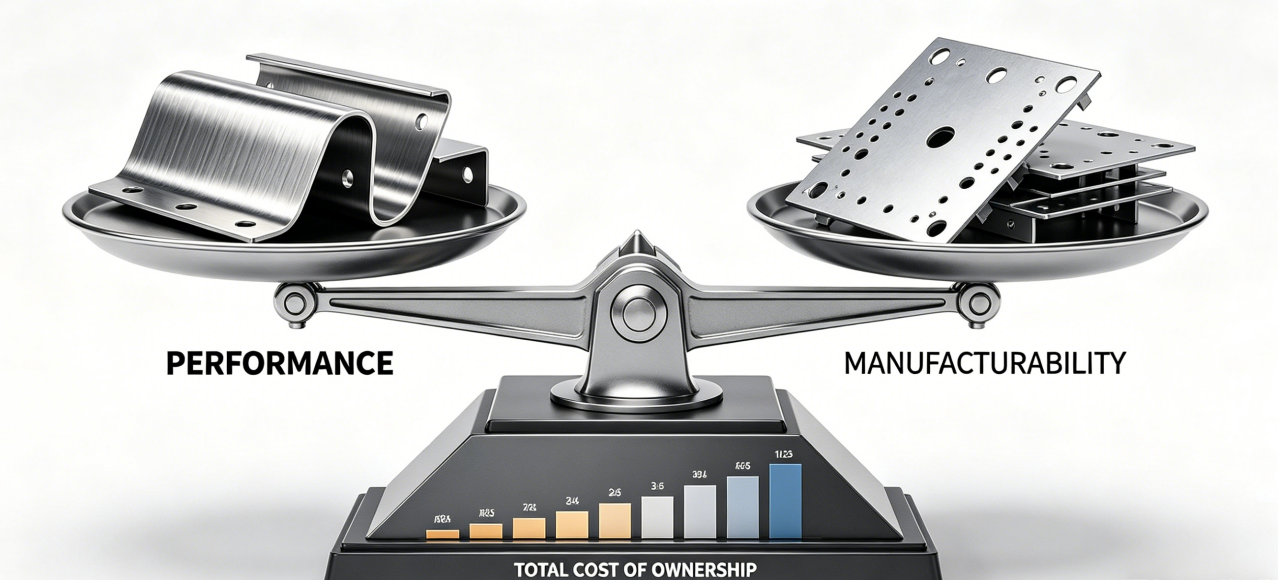
Choosing between titanium and steel is a systems engineering problem balancing performance, manufacturability, and total cost. The key to success lies in looking beyond static datasheets, developing a deep understanding of how materials behave in real-world processes like cutting, bending, and welding, and validating choices early through rapid prototyping iterations.
Facing a complex sheet metal material selection decision and seeking a reliable partner offering comprehensive services from DFM analysis and prototype validation to volume production? Upload your part drawings today to receive a professional proposal with a detailed process roadmap and cost analysis.
Author Bio
H2:FAQs
Q: For an outdoor enclosure requiring maximum lightweight and corrosion resistance, should I choose titanium or stainless steel?
A: For extreme environments with long-term exposure to salt spray or chemicals, titanium alloy (e.g., Grade 2) is often the superior choice due to its exceptional corrosion resistance and higher specific strength, despite the higher cost. For general outdoor environments, 316L stainless steel offers better cost-effectiveness.
Q: What is the typical Minimum Order Quantity (MOQ) for sheet metal fabrication? Can I make just one prototype?
A: Professional service providers typically support flexible orders from single prototypes to high-volume production. There is usually no MOQ restriction at the prototype stage, as the focus is on validating the design and process to pave the way for subsequent mass production.
Q: How to ensure the precision of welded sheet metal assemblies, especially for multi-part configurations?
A: High-precision laser cutting ensures part consistency, and this is key when combined with dedicated welding fixtures and jigs for positioning. For assembly surfaces with stringent requirements, secondary machining after welding can be added to guarantee final accuracy.
Q: What are the universal design rules to follow during the sheet metal design phase?
A: Key rules include: minimum bend radius (typically 1x material thickness), minimum distance from holes/slots to edges (≥2x material thickness), and designing relief notches for adjacent bends. Following these helps avoid cracking and deformation.
Q: How do you protect the design drawings and intellectual property submitted by clients?A: Reputable suppliers strictly enforce Non-Disclosure Agreements (NDAs), store project files in encrypted systems, and restrict access in production areas. Upon project completion, digital files can be deleted per the client’s request.